


 Chat on LINE






How to look after a pool yourself: daily, weekly and monthly jobs
Short answer
Looking after a pool yourself comes down to three jobs: keep free chlorine at 1–3 ppm and pH at 7.2–7.6, run the filter 8–12 hours a day, and keep the pool clean. Test the water 2–3 times a week, skim and empty the baskets daily, brush and vacuum once a week, and shock once a week.
Water values to keep
| Value | Target range | How often to test |
|---|---|---|
| Free chlorine | 1–3 ppm | 2–3 times a week; daily when the pool is busy |
| pH | 7.2–7.6 | 2–3 times a week |
| Total alkalinity | 80–120 ppm | Weekly |
| Cyanuric acid (stabiliser) | 30–50 ppm | Monthly |
| Calcium hardness | 200–400 ppm | Monthly |
| Phosphate | Below 100 ppb | Monthly, or when algae keep coming back |
Home test kits read 2–5 values; the Pool Pro&Lab lab measures more than 11. Have the water tested every 3–6 months.
Pool care schedule
| How often | What to do |
|---|---|
| Daily | Skim leaves and debris, empty the skimmer basket, keep the water about halfway up the skimmer mouth, run the filter 8–12 hours |
| 2–3 times a week | Test chlorine and pH, adjust, top up chlorine |
| Weekly | Brush the walls and waterline, vacuum the floor, shock in the evening, add algaecide, backwash when the filter pressure is about 0.5 bar above clean |
| Monthly | Test alkalinity, cyanuric acid, hardness and phosphate; check the pump, pipes and control box |
| Every 3–6 months | Lab water test, soak the cartridge in filter cleaner, check the filter sand |
The weekly routine
- Step 1: Skim and empty the basketsSkim the surface, then empty the skimmer and pump baskets. Leaves left to sink stain the pool and feed algae.
- Step 2: Brush the walls and waterlineBrush from the waterline down to the floor, and wipe the greasy waterline with Pool Cleaner. Never use household cleaners or wire brushes.
- Step 3: Vacuum the floorUse a vacuum head or a robot cleaner to pick up what has settled on the floor.
- Step 4: Test the waterTest free chlorine, pH and alkalinity with strips or a test kit.
- Step 5: pH first, then chlorineBring the pH to 7.2–7.6 first, where chlorine works best, then add chlorine to reach 1–3 ppm.
- Step 6: Shock and add algaecideShock in the evening once a week. The next day, add Metal-Free Algaecide at 60 ml per 10 m³ to keep algae away.
- Step 7: Backwash when the pressure risesWatch the filter's pressure gauge. When it reads about 0.5 bar above a clean filter, backwash, then rinse.
How many hours a day should the filter run?
The filter should pass the whole pool's water through at least once a day, so most home pools run 8–12 hours a day, longer in the hot season or when busy. For example, a 50 m³ pool with a pump moving 10 m³ an hour takes 5 hours per turnover; 10 hours gives about two.
For the filter, plant room and control box in more detail, read 7 steps to clean a skimmer pool.
Frequently asked questions
Is it hard to look after a pool yourself?
Not if you keep at it. A typical home pool takes about 15 minutes a day and an hour a week. What matters most is testing regularly and never letting the chlorine run out.
What equipment do I need?
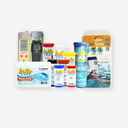
A test kit or strips, chlorine, pH adjusters, shock, a pool brush, a leaf net, and a vacuum head and hose or a robot cleaner. See the pool maintenance kits.
What should I do after heavy rain?
Skim, test pH and chlorine, and shock in the evening: rain dilutes chlorine and washes dust and phosphate in. If the pool overflowed, lower the level to about halfway up the skimmer mouth.
How often should I change the pool water?
A well-kept pool never needs a full change. Replace part of the water when cyanuric acid passes 100 ppm or hardness gets high enough to cloud the water. Weekly backwashing also swaps out some water.
Products in this guide
- Insta-TEST® 5 PlusView at PoolBestBuy
- Test Kit RefillView at PoolBestBuy
- TCCA Granular ChlorineView at PoolBestBuy
- Shock ChlorineView at PoolBestBuy
- pH MinusView at PoolBestBuy
- pH PlusView at PoolBestBuy
- Supreme METAL FREE ALGAECIDEView at PoolBestBuy
- Pool CleanerView at PoolBestBuy
- Pool Maintenance KitsView at PoolBestBuy
Buy online from our partner store, PoolBestBuy