

 Chat on LINE






What should a pool's pH be, and how do I adjust it?
Short answer
Pool water should have a pH of 7.2–7.6: in that range chlorine disinfects well, swimmers' eyes don't sting and equipment doesn't corrode. If the pH is below 7.2, add pH Plus or sodium carbonate; if it is above 7.6, add pH Minus or sodium bisulphate, a little at a time, and test again after 4–6 hours.
What each pH level does
| pH | What happens |
|---|---|
| Below 7.0 | Acidic water: stinging eyes and skin, corroded stainless ladders, pumps and grout, chlorine used up fast |
| 7.2–7.6 | The right range: chlorine works well and the water is comfortable |
| 7.8–8.0 | Chlorine works far less well, the water starts to cloud and algae grow easily |
| Above 8.0 | Scale on the walls and in the filter, cloudy water, green pools |
At pH 7.5 about half the chlorine in the water is in its strong, disinfecting form (hypochlorous acid); at pH 8.0 only about a fifth is. So set the pH before you add chlorine.
How to test pH
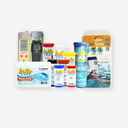
- Use a chlorine and pH test kit, test strips or a pocket pH meter.
- Take the sample about an elbow's depth below the surface, away from the return jets, before the day's chemicals go in.
- Test 2–3 times a week, and after heavy rain or a busy day in the pool.
How to adjust pH, step by step
- Step 1: Test pH and alkalinityIf total alkalinity is below 80 ppm the pH swings easily. Fix alkalinity first, then the pH.
- Step 2: Work out the dose from your pool sizeUse the table below. A 50 m³ pool at pH 7.9 needs to come down 0.3: 10 g of pH Minus × 50 m³ × 3 = 1.5 kg. Add half first, because every pool responds a little differently.
- Step 3: Dissolve it in a bucketFill a plastic bucket with pool water first, then add the product and stir until it dissolves. Never pour water onto the chemical.
- Step 4: Pour it in with the filter runningPour it into the skimmer or around the pool near the return jets while the pump runs. Take any other chemical out of the skimmer basket first.
- Step 5: Wait 4–6 hours and test againDon't add more straight away. Let the water circulate, test again and adjust in small steps until the pH is 7.2–7.6.
pH doses by pool size
| Pool volume | Raise pH 0.1: pH Plus or sodium carbonate | Lower pH 0.1: pH Minus or sodium bisulphate | Raise alkalinity 10 ppm: Alkalinity Up |
|---|---|---|---|
| 10 m³ (10,000 litres) | 50 g | 100 g | 200 g |
| 25 m³ (25,000 litres) | 125 g | 250 g | 500 g |
| 50 m³ (50,000 litres) | 250 g | 500 g | 1 kg |
| 100 m³ (100,000 litres) | 500 g | 1 kg | 2 kg |
Approximate rates from the labels of Pool Pro&Lab products. Supreme pH Up and pH Down have their own table on the label. Don't know your volume? See how to work out pool volume.
How alkalinity (TA) affects pH
Total alkalinity is the buffer that keeps the pH steady. Keep it at 80–120 ppm (150 at most). When it is low the pH moves fast: add Alkalinity Up at 200 g per 10 m³ to raise it 10 ppm. When it is above 150 ppm the pH keeps climbing: lower it with pH Down at 15 g per 10 m³ for each 10 ppm.
Frequently asked questions
What is the right pH for a swimming pool?
7.2–7.6. At 7.4–7.6 the water is close to the pH of human tears, so it doesn't sting, and chlorine still works well.
Why does my pool's pH keep rising?
Common causes are high alkalinity, fountains or waterfalls that agitate the water, new plaster or grout, and salt chlorinators, which push the pH up naturally. Test alkalinity first; if it is above 120 ppm, bring it down gradually.
What happens if the pH is too low?
Water below pH 7.0 corrodes metal, grout and the pool surface, stings eyes and skin and burns through chlorine. Add pH Plus a little at a time until it reaches 7.2.
How soon can I swim after adjusting the pH?
Wait at least an hour so the product dissolves and spreads through the pool, then check the pH is between 7.2 and 7.6.
Products in this guide
- pH PlusView at PoolBestBuy
- pH MinusView at PoolBestBuy
- Sodium Carbonate
- Sodium Bisulphate
- Supreme ALKALINITY UPView at PoolBestBuy
- Supreme pH DOWNView at PoolBestBuy
- Test Kit RefillView at PoolBestBuy
- pH Waterproof PockeTester™
Buy online from our partner store, PoolBestBuy