


 Chat on LINE






Cloudy pool water: how do I fix it?
Short answer
Cloudy pool water usually comes from low chlorine, a pH or alkalinity that is too high, or a filter that doesn't run enough, so fine particles stay in the water. Bring the pH to 7.2–7.6, shock if chlorine is low, clean the filter and run it for 24 hours; if it is still cloudy, use a clarifier or a flocculant and vacuum up what settles.
What makes pool water cloudy
| Cause | Signs | Fix |
|---|---|---|
| Low chlorine | Greenish haze, slippery walls | Shock in the evening |
| High pH or alkalinity | White haze, white crust at the waterline | Lower the pH with pH Minus |
| Dirty filter or too little filtering | Cloudy everywhere, high filter pressure | Clean the filter; run it 8–12 hours a day |
| Dust, rain or new water | Cloudy after rain or after filling | A clarifier or a flocculant |
| High hardness | White haze, scale on the pool surface | Test at the lab; you may need to replace part of the water |
How to clear cloudy pool water, step by step
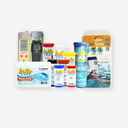
- Step 1: Test pH, chlorine and alkalinityMulti-test strips read them all at once. If the haze is greenish, follow the green pool guide instead.
- Step 2: Bring the pH to 7.2–7.6If the pH is high, add pH Minus at 10 g per m³ for each 0.1. Start with half and test again after 4–6 hours.
- Step 3: Shock if chlorine is below 1 ppmShock in the evening and run the filter overnight. Enough chlorine breaks down the dirt that clouds the water.
- Step 4: Clean the filterBackwash a sand filter until the sight glass runs clear, then rinse. Take out and hose a cartridge, and soak it in filter cleaner if it's old.
- Step 5: Run the filter for 24 hoursKeep the pump on for a full day. Dust haze often clears by itself after several turnovers.
- Step 6: Clarifier or flocculantFor a slight haze, add Super Clear at 40 ml per 10 m³ (80 ml if very cloudy) and let the filter catch it. For heavy cloudiness, add Fast Floc at 200 ml per 10 m³ at pH 7.5–7.8; it settles in 3–6 hours, then vacuum it up.
Clarifier vs flocculant
| Clarifier | Flocculant | |
|---|---|---|
| How it works | Clumps fine particles so the filter can catch them | Binds particles into heavy clumps that sink to the floor |
| Use it for | Slight to moderate haze | Heavy cloudiness, or after clearing a green pool |
| Afterwards | Run the filter as usual | Wait for it to settle, then vacuum it up |
| Products | Super Clear, Maxi Clear (skimmer tablets for sand filters) | Fast Floc, Pool Floc |
Doses by pool size
| Product | 10 m³ | 25 m³ | 50 m³ | 100 m³ |
|---|---|---|---|---|
| Super Clear, routine | 40 ml | 100 ml | 200 ml | 400 ml |
| Super Clear, very cloudy | 80 ml | 200 ml | 400 ml | 800 ml |
| Fast Floc | 200 ml | 500 ml | 1 litres | 2 litres |
| Maxi Clear (25 g tablets) | 1 tablets | 1 tablets | 1 tablets | 2 tablets |
| Pool Floc | 400 g | 1 kg | 2 kg | 4 kg |
Doses from the labels of Pool Pro&Lab products. Don't know your volume? See how to work out pool volume.
Frequently asked questions
What causes milky white pool water?
Usually high pH or alkalinity, high hardness, or a filter that can't keep up with fine particles. A greenish haze is usually algae starting: see how to fix green pool water.
Can I use alum to clear a cloudy pool?
Alum (aluminium sulphate) is a flocculant, and it is the main ingredient of Pool Floc and Maxi Clear. Use a product made for pools at the dose on the label: too much lowers the pH and makes the water cloudier.
Which filters can I use a flocculant with?
Fast Floc works with sand and cartridge filters; its label advises against D.E. filters. After flocking, if the filter valve has a Waste setting, vacuum the sediment straight out of the system rather than through the filter.
The readings are normal but the water is still cloudy. What now?
Clean the filter and run it for longer. If it stays cloudy, bring a sample to the lab to measure hardness, phosphate and metals, which home kits can't.
Products in this guide
- Supreme SUPER CLEAR
- Supreme FAST FLOCView at PoolBestBuy
- Supreme MAXI CLEAR SKIMMER TABLETView at PoolBestBuy
- Supreme POOL FLOCView at PoolBestBuy
- Supreme NATURAL FILTER CLEANER & DEGREASERView at PoolBestBuy
- pH MinusView at PoolBestBuy
- Insta-TEST® 5 PlusView at PoolBestBuy
Buy online from our partner store, PoolBestBuy